17 January 2016

The Maritime Museum

Next stop after the Cutty Sark and lunch was the brilliant Maritime Museum. We're lucky having so many free museums in London offering information, history and great exhibitions.


The National Maritime Museum Greenwich is the leading Maritime museum of the UK and may be the largest museum of its kind in the world. This historic building forms part of the Maritime Greenwich World Heritage site, which also incorporates the Royal Observatory and the 17th century Queen's House. 

I took 114 photos! no please don't go, I'm not going to show you all of them,
but it has been difficult deciding which ones to use.


King George V battleship built by Vickers-Armstrong Ltd in 1940 
difficult to see properly with reflections from the glass.

Buoys and Beacons
Herberts patent floating buoy; Herberts patent floating lighthouse; The Kentish Knock. 
The Kentish Knock was a Trinity House light vessel stationed in the Thames estuary. Light vessels had to be towed to and from their station. They were manned by a crew of ten. Traditionally they were painted red to make them conspicuous in daylight.


Eddystone lighthouse painted by Isaac Sailmaker. The Eddystone was the first offshore rock to be marked by a lighthouse. The original lighthouse was washed away in the great storm of 1703. The tower in this painting is its replacement.

                                                                                              The components needed


Grace Darling was the daughter of the keeper of the Longstone lighthouse. One stormy night in 1838 a paddle steamer was wrecked on some nearby rocks. Grace and her father, William 
set out into the gale in their open rowing boat to rescue the survivors.


Ajax and Bulldog figureheads. 
Ajax the warrior was celebrated in ancient Greek mythology.
The bulldog is a symbol of British aggression and tenacity. 
The leaping bulldog has the words CAVE CANEM (beware of the dog) inscribed on its collar. 


My favourite, Sunbeam, the child angel. It's a sad one. This gold painted half length figurehead was commissioned for politician Thomas Brassey's (later Earl Brassey) steam yacht "Sunbeam". It was based on his daughter Constance, whose nickname was Sunbeam. Born in Feb 1868, only four years into her little life she died of scarlet fever.


Ship's badges 

In 1894 the Royal Navy abolished figureheads for major vessels, after the introduction of new steam powered iron ships. In 1918 badges were introduced as the official symbol of a ship's identity.


Travelling in style
Frederick's Barge. In 1732 this limousine barge was built for Frederick, Prince of Wales. 
In the 18th century travelling by boat on the Thames was the fastest way to get around.


The Traders: the East India Company and Asia gallery.

For over 250 years the East India Company shaped trade between Britain and Asia, becoming enormously wealthy in the process and even taking on pirates with its own navy. This gallery looks at the commodities the company traded, the people who shaped its tumultuous career and the conflicts and rebellions that were its ultimate undoing, as well as its continuing impact on the world today.

The gallery features Japanese, Chinese and Burmese swords; beautifully crafted ship models and navigational instruments; Nelson’s Japan-pattern breakfast service; medals, journals, timepieces, spices, fabrics that shaped our fashions, tea which transformed from a luxury to a favourite national past time. Also involvement in the drug trade, resulting in two wars with China.

Opium was outlawed by the Chinese authorities 
but demand for it was provided by imports from India. 
This thriving illegal trade was the darker side of Britain's insatiable taste for tea.


HMS Seringapatam was a 46 gun warship launched at the Bombay dockyard in 1819.
This quirky chap was her figurehead.
It's thought to represent Tipu Sultan of Mysore riding a roc - a mythical bird of great strength.
As the ruler of an extensive empire in southern India, Tipu opposed the extension of Company rule in India.


Admiral Sir William Sidney Smith, Admiral James de Saumarez, Admiral Sir Edward Pellew and Captain Sir William Peel. What fine, handsome chaps they were.


This beautiful tranquil area houses stained glass windows 
from the Baltic Exchange building known as the half-dome. 
It is a fusion of classical and religious symbolism which celebrates the heroism and triumph of war. 
I'm not sure war is held in such high esteem nowadays though. 


The stunning Virtue Windows depict Hope, Fortitude, Justice, Truth and Faith.
The Romans established a long list of virtues as qualities to which all human beings should aspire. 

The virtues are common themes in Medieval and Renaissance art, 
where they are traditionally depicted as women


The Navy offered rewards for all those who joined. When an enemy ship was captured it and its cargo became a legal "prize". When the cargo was sold the gains were shared among the captors.
The prize money was sometimes a vast fortune and although the captain and officers took the majority, seamen also received a share.


Frigates were the workhorses of the Navy. 
They escorted convoys, acted as scouts, carried information and attacked enemy trade.


The Borough of Dover freedom casket 1918-19 was presented to Vice-Admiral Sir Roger Keyes
for his role in planning the Zeebrugge raid 


City of Hull freedom casket 1919-20 was presented to Admiral Beatty.
Hull was a key port for supplying seamen and vessels to the war effort.

There is also the excellent Nelson gallery and one covering both world wars but I only
had time to either enjoy the displays or rush around taking photos, I chose the former.

We finished our day at the Royal Observatory - up next

10 January 2016

Greenwich

The Royal Borough of Greenwich. Home to many grand old buildings and establishments, great markets, quirky shops and loads of history, there is so much to do, to see, atmosphere to soak up,
something for everyone. 

My most recent visit was towards the end of November, I had my grandson with me, I was anxious about security, but I wasn't going to change my plans and my daughter shared my feelings.

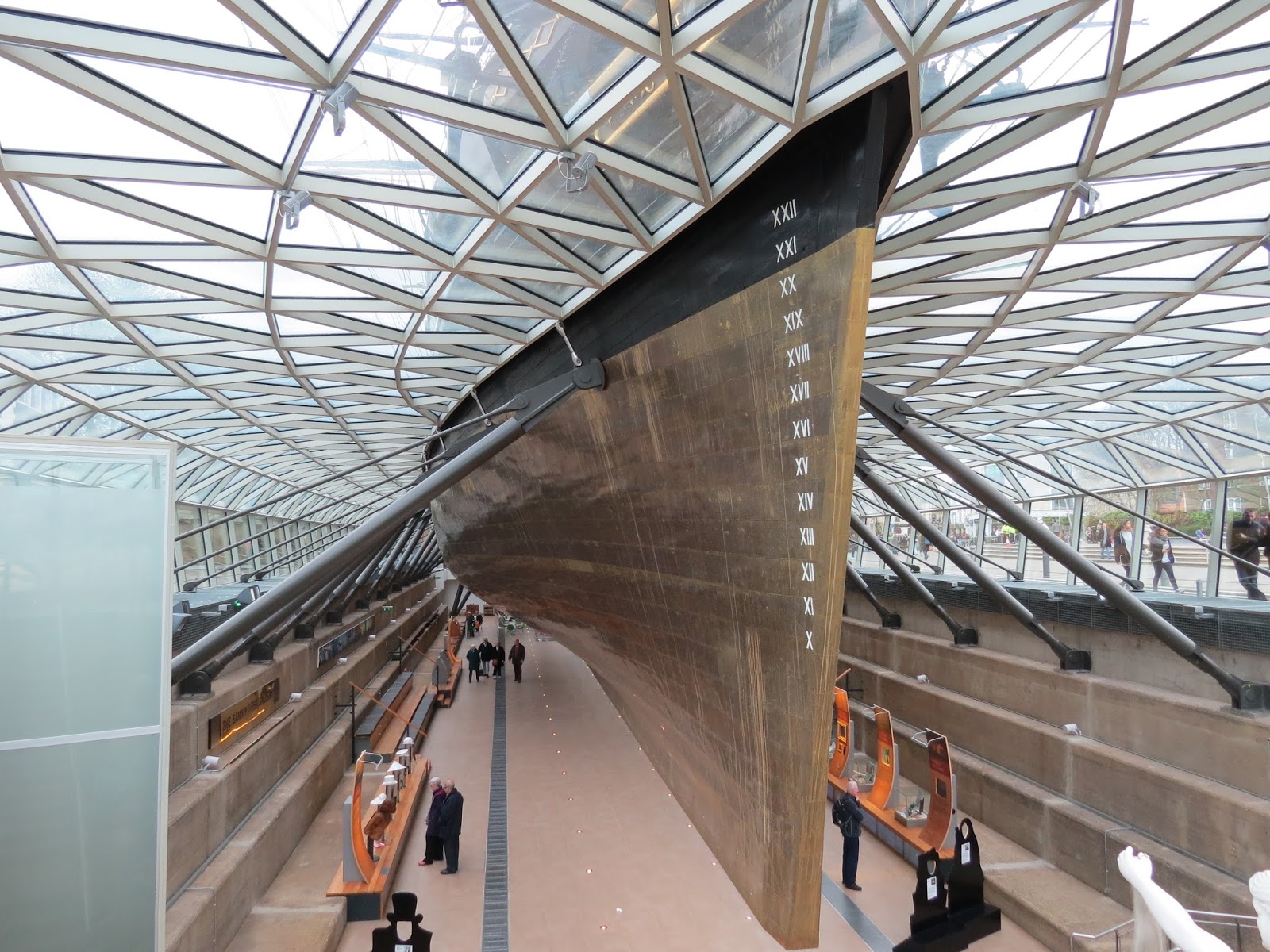
Perhaps one of the oldest and most famous residents is this lovely old ship.  


The Cutty Sark was once the most famous of the great clippers - the fast sailing ships of the nineteenth century that traversed the world’s major trading routes. 


She was built on the Clyde in 1869 for the Jock Willis Shipping Line, commissioned by shipping magnate Jock "Whitehat" Willis who operated the shipping company founded by his father. The ship was named after Cutty-sark, the nickname of the witch Nannie Dee in Robert Burns's 1791 poem Tam o' Shanter


The ship's figurehead, attributed to carver Fredrick Hellyer of Blackwall, is a stark white carving of a bare-breasted Nannie Dee with long black hair holding a grey horse's tail. In the poem she wore a linen sark (a short chemise or undergarment), that she had been given as a child, which explains why it was cutty - far too short. The sight of her dancing in such a short undergarment caused Tam to cry out "Weel done, Cutty-sark". Originally, carvings by Hellyer of the other scantily clad witches followed behind the figurehead along the bow, but these were removed by Willis in deference to 'good taste'.


The white painted metalwork is part of the original iron framework. Almost all of it dates back to 1869 when the ship was built. The grey metalwork has been installed to support the original structure. The Cutty Sark was a masterpiece of sailing ship design. Her hull of timber and iron was sleek and strong and her three canvas masts propelled her to speeds of up to 17 knots. As a result she spent the 1870's speeding across the high seas, establishing a reputation as one of the fastest ships afloat. Speed was a major advantage to a merchant ship and created prestige for the owners. As well as prestige her speed also secured handsome profits, bringing the new tea crop from China to the fashionable tearooms and parlours of Victorian Britain.


So precious was this new commodity that when it was first brought to Europe
it was kept under lock and key in tea caddies.


The skilled Chinese stevedores could load more than 10,000 tea chests in two or three days. 
Bamboo matting covered with canvas made sure that the tea
was kept dry if water seeped through from the main deck.

The annual tea race was a Victorian sensation, the progress of the ships was  reported by telegraph and could be followed in the newspapers. Huge bets were laid on the outcome. The Cutty Sark was never first to the finish line, but she was still one of the fastest. In 1872 she was involved in one of the most famous tea races of all time, against the Thermopylae. The two ships were neck and neck until the Cutty Sark lost her rudder in heavy seas in the Indian Ocean. The accident meant Thermopylae beat her back to London by 7 days, but the Cutty Sark’s performance was nevertheless remarkable.

Whilst the opening of the Suez Canal offered steamships a shorter route to the Far East, cutting approximately two months off their journey time, the winds of the Red Sea and the Mediterranean were not suited to the clippers. Consequently, the increasing speed and cargo capacity of steamships soon rendered sailing ships unprofitable. By the late 1870s, the Cutty Sark had been pushed out of the tea trade and her future looked bleak. In 1880 she set off on a voyage to Japan delivering coal for the American Pacific fleet. She never completed the voyage though. A fight amongst the crew left one man dead, and when the man responsible was allowed to escape by the captain, the rest of the crew mutinied. The ship’s captain, realising his career was ruined, committed suicide by stepping off the ship’s stern into the sea. 
These dark events gave the Cutty Sark a new reputation amongst sailors, as a ‘hellship’ and a cursed vessel. The worst possible reputation for a ship. Determined to turn her fortunes around, in 1885 Jock Willis hired an excellent, eccentric clipper captain named Richard Woodget. Captain Woodget recognised that the Cutty Sark’s commercial advantage now lay in the dangerous wool run to Australia.


In this arena the Cutty Sark once again excelled, setting speed records between London, 
Melbourne and Sydney. 
She also carried whisky at least once as part of a general cargo from London to Sydney in 1890. 
The Cutty Sark brand of whisky was created in 1923. 


It's thought that she also carried coffee and silk and private cargo.


In 1886 in Shanghai, Captain Woodget acquired a bicycle like this one
which he learnt to ride on the tween deck. 
He also learnt to roller skate!

For a decade Cutty Sark established her fame through her lightning voyages, but by 1895, she was approaching the end of her life expectancy and had ceased to be profitable. After her heyday, she was sold to a Portuguese company, who renamed her the Ferreira. The ship spent 25 years transporting cargoes between Portugal, Africa and the Americas, and managed to avoid German U-boats during World War I. 


In 1922 she was purchased by Captain Dowman, a former clipper who remembered her from her glory days. Dowman renamed her the Cutty Sark and brought her to Falmouth, where she was restored and opened to the public. 
Upon Dowman’s death in 1936, the ship passed to the navy Training College at Greenhithe to be used as a training ship by British naval cadets. Aboard her, a generation of Royal and Merchant Navy cadets were trained on how to work a sailing ship. 
Time finally ran out for the Cutty Sark after World War II, when the College got a new training ship. Now facing the scrapyard, the Cutty Sark was once again rescued from obscurity. 
In 1951, the Cutty Sark Society had been established by her admirers. With the support of the public and the Society’s patron, the Duke of Edinburgh, funds were raised to rescue her. 
In 1954, she was placed in dry dock in Greenwich, London where  she served as a unique example of breathtaking ship design and as a symbol of Britain’s proud maritime heritage. She also became the memorial to the Merchant Navy and its losses in two world wars.
Over the decades, the same timbers that were once pounded by the storms of the Cape Horn came under new threat. Years of exposure to the elements took their toll. Her wooden hull was waterlogged and rotting and the iron frame that supported them was rusting. In 2007 comprehensive conservation of the ship was started. 
She has been damaged by fire twice, firstly in May 2007. Thankfully, she was undergoing restoration work at the time, and about fifty per cent of the ship had been removed, including the iconic figurehead, the masts and rigging, the coach house, and a significant amount of planking, so the damage could have been a lot worse. She was restored and reopened to the public on 25 April 2012. Secondly, on 19 October 2014 she suffered minor damage in a smaller fire.
In her long life she has faced the scrapyard many times. But thanks to good fortune and the hard work of her admirers, today she is the last tea clipper to survive. For fifty years she has stood in dry dock in Greenwich, where she has become a top tourist attraction and famous London landmark. 

She is, not least, a unique link to Britain’s proud maritime past.


She has been beautifully renovated

A bit of fun steering a virtual ship from Australia to England. 
Captain Woodget did it in 73 days.


                           My grandson did it in 84 days            I took 94 days, I went the wrong way round!!


         Master's Cabin                Captains dining room


“Heads” seems a strange description for a toilet! 
It derives from the fact that the toilet on a marine vessel was located at the front of the ship (the head), 
so that water from the sea that splashed up on the front of the boat would wash the waste away. 
The term is thought to have been used as early as the 17th century. 


As an army marches on its stomach, so too I imagine sailors sail on theirs. 
Everyone on a ship is important but probably one of the most important people is the cook. 


As we were looking around on deck I was suddenly aware that I could hear animal noises -  pigs to be precise, then I spotted it, no not a real pig, a pretend one. Livestock were taken on board for food.


Now I suspect you're going to have a bit of a chuckle here. For years I thought that short bunks were an indication of short sailors!! I know I know, shame, but the real reason didn't occur to me. A very nice man acting as Jock "Whitehat" on the ship explained that they were designed that way so that the men would repose with their legs bent thus ensuring that their sleep wouldn't be disturbed by constant rolling around - simple. I wonder if they wore knee pads!


The Long John Silver Collection of Figureheads was given to Cutty Sark in 1953 by Sydney Cumbers, also known as Long John Silver because of his eye patch and his love of all things maritime.

Does the figure in blue holding the flower remind you of anyone?

Thank you for reading, hope you've enjoyed this little bit of history. 
Don't miss the next installment - the brilliant Maritime Museum :-)

5 January 2016

A Good Read

Rabbit Proof Fence by Doris Pilkington (pseudonym of Nugi Garimara) 
The remarkable true story of three young girls who cross the harsh Australian desert on foot to return to their home. 
Western Australia, 1931. Government policy dictates taking half-caste children from their Aboriginal mothers and sending them a thousand miles away to what amounts to indentured servitude at Government settlements, disguised as "saving them from themselves".
Molly, Daisy, and Grace (two sisters and a cousin aged 14, 10, and 8) arrive at their Gulag and promptly escape. Under Molly's lead they walk north, following a fence that keeps rabbits from settlements, eluding native trackers and the regional constabulary. Their pursuers take orders from the government's "chief protector of Aborigines," A.O. Neville, blinded by Anglo-Christian certainty, evolutionary world view and conventional wisdom. 
The girls eventually make it back to their home and family only to be re-captured and sent back. 
A very good read.  An absorbing history of the treatment of Aboriginals by the “We know what’s best for you” brigade.  But the “protector” of Aborigines failed to understand the bond between families, and the determination of the girls to want to be with their loved ones no matter what.

2 January 2016

Specs Saver

I have 5 pairs of glasses. Two are prescription glasses that are kept in their respective cases when not in use, the others are reading glasses. two of which have cases, the other one doesn't have a case. One pair with case is usually on my bedside table, the other pair with case is usually downstairs somewhere - in the kitchen or on a table beside a chair or sofa, and the third pair floats around. This is the pair I favour but can't always find because I have a habit of just putting them down anywhere. So look what my lovely son-in-law bought me for Christmas


how cool is this


It reminds me of the statues on Easter Island

So far I'm putting my glasses in it every time I use them so
I know exactly where they are next time I need them!


24 December 2015

Merry Christmas From Rufus, Buster and Moi


Can't believe it, Christmas Eve and I've mowed the lawn! it's been bugging me for a while. I didn't spend too much time on it and I didn't trim the edges but it looks much better.

Ham sandwich for lunch, then we're off to see Star Wars
followed by a bite to eat and a few cocktails at TGI Friday.

I've been writing my cyberspace diary for just over a year now,
thank you for reading my posts and the lovely comments you have left. 

I hope you have a very merry Christmas.

21 December 2015

Buster's Diary

Rufus has hurt his paw again, it's very red and sore and he's hopping around on three legs, so no walks for him for a day or two. Our walks are very wet and muddy at the moment, two songs go through SL's mind when we're out - Mud Glorious Mud and Slip Sliding Away. 
Part of our walk takes us across or beside this small stream, depending on the water level.

That's me having run through the water, it wasn't very deep then.

Some kind person has strung this very strong nylon rope around the tree to help get down the bank, it's not a long way down but when it's muddy it's like an out of control slalom course. SL holds onto the rope and abseils down into the water then she wades across. 


Getting out on this side is slightly easier because although it's muddy it isn't quite so steep.

We don't have to cross the stream but it is a nice walk through some fields and it avoids a really bad muddy area. The other day Rufus and SL had crossed over, the level was high, it reached almost to the top of SL's boots. I was still on the other side refusing to cross. SL called me a wuss which I think was a tad harsh, I'm shorter than Rufus, the water would probably have been up to my undercarriage. She tried coaxing me with tasty treats but there was no way I was crossing that stream. SL had to find a broken tree branch to act as a kind of walking pole to help her cross back. She wasn't best pleased.


The problem with weather like this is having to be hosed down when we get home, we don't like that. SL ties us up, goes indoors, comes out with her rubber gloves on and hoses us down, mmm I think some people would pay to have that done to them!! anyway where was I? oh yes, mostly it's just feet and legs, but occasionally it's the undercarriage as well, oh the indignity....